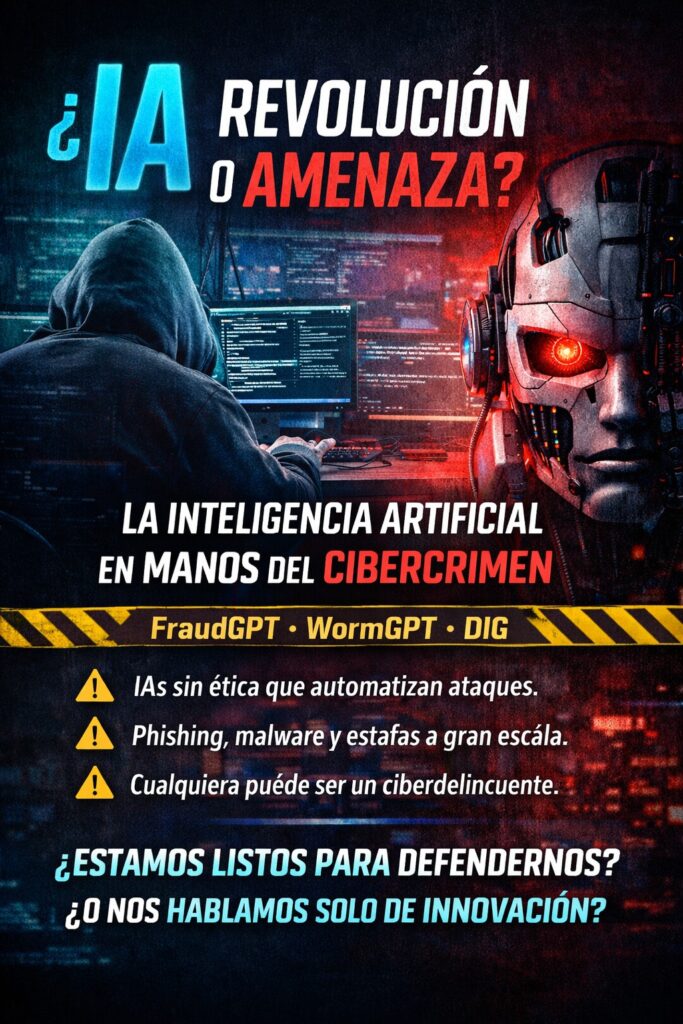


By: Dr. David Asencio Fiestas Expert in Artificial Intelligence, Digital Transformation, and Cybersecurity
For years, we have discussed Artificial Intelligence (AI) as a tool to enhance productivity, optimize processes, and transform industries. However, there is a reality we cannot ignore: AI is also being weaponized as a digital asset.
A recent analysis of the cybersecurity ecosystem reveals the emergence of tools such as FraudGPT, WormGPT, and DIG—AI models created without ethical boundaries and designed to facilitate fraud, phishing, and large-scale cyberattacks.
🧠 Unethical AI: When Technology Becomes Dangerous
Unlike responsible models, these AIs—which circulate primarily on the dark web—enable the generation of:
- Extremely credible phishing messages
- Malicious code without the need for advanced technical knowledge
- Automated scams and social engineering attacks
- Mass exploitation of vulnerabilities
The core issue is not just the technology itself, but that it drastically lowers the barrier to entry for cybercrime. Today, anyone can execute complex attacks simply by “prompting” a malicious AI.
🚨 Cybercrime Enters a New Era
We are transitioning from a landscape dominated by specialized hackers to one where digital crime is AI-assisted.
This shift implies:
- Faster attacks
- A higher volume of threats
- Reduced reaction time if we are not adequately prepared
In this increasingly automated environment, corporations, governments, and ordinary citizens alike become potential targets.
🛡️ The Answer is Not to Halt AI, but to Use It Better
Based on my experience in technology and innovation, one thing is clear: the solution is not to reject Artificial Intelligence, but to use it responsibly.
We require:
- Defensive AI to detect threats in real-time
- A cybersecurity culture within organizations and teams
- Digital education for both users and leaders
- Clear ethical and regulatory frameworks
The paradox is evident: only through responsible AI can we defend ourselves against malicious AI.
🌐 Final Reflection
Artificial Intelligence is neither inherently good nor evil. It is an amplifier of human intent. Today, more than ever, the challenge is not merely technological, but human, strategic, and ethical.
The digital future is already here.
👉 The question is whether we are prepared to protect and lead it consciously.
Source: Base Article: “DIG, FraudGPT y WormGPT: las IA del cibercrimen” Published in WeLiveSecurity (ESET)
To ensure your article meets the highest publication standards, I can help refine the professional presentation of the text.
- Adapting the text for a specific LinkedIn post
- Generating a formal executive summary
- Creating a list of English keywords for SEO