

Expert in Artificial Intelligence, Digital Transformation, and Cybersecurity
Every day, millions of people consume content created by systems with no identity, no lived experience, and no human intent—yet they inform, persuade, and shape decisions.
This is not an isolated trend. It is a structural shift.
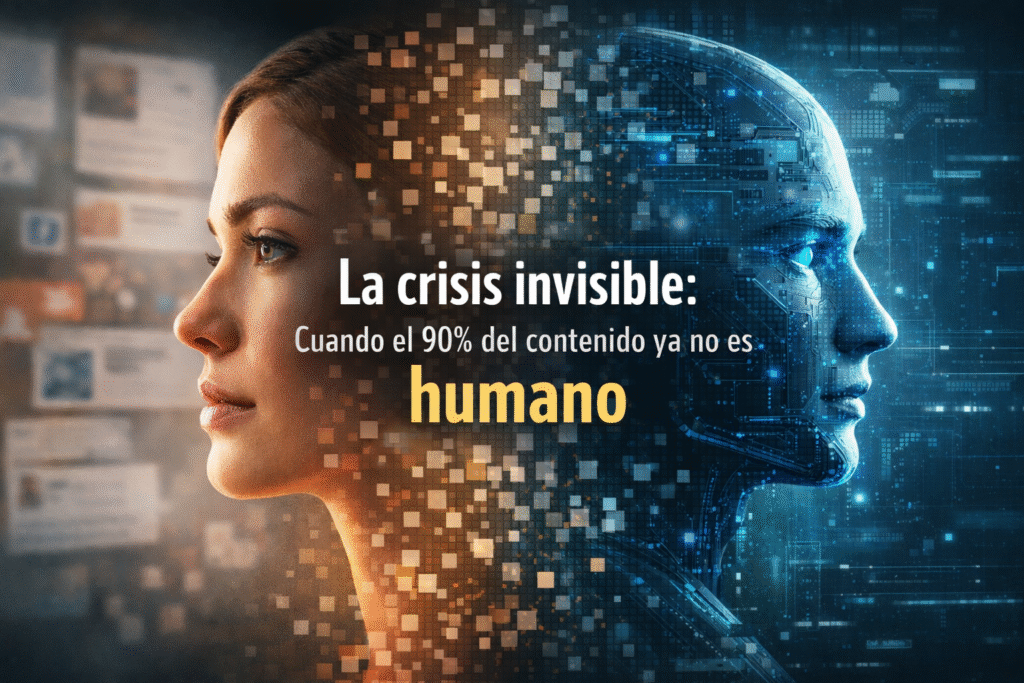
Projections suggest that in the coming years, up to 90% of digital content will be generated, either partially or entirely, by artificial intelligence. More than a technological evolution, this marks a profound transformation in how we understand information, truth, and trust.
From Human Creation to Algorithmic Production
For decades, content was a direct extension of human thought. Today, artificial intelligence has transformed that process into a scalable, automated, and continuous system.
Content no longer depends on time, expertise, or context. It can be produced in seconds, at scale, and with a level of quality that is increasingly indistinguishable from human output.
The result is an oversaturated ecosystem where abundance replaces judgment, and speed overtakes reflection.
The Erosion of Trust
The core challenge is no longer the volume of content, but the difficulty of verifying its origin.
When images can be artificially generated, voices cloned with precision, and text can simulate complex reasoning, truth is no longer self-evident.
This gives rise to a new reality: a structural crisis of digital trust.
In this environment:
• Users consume information with growing skepticism
• Brands face increasing demands for transparency
• Media outlets compete not only for attention, but for credibility
Information overload no longer brings clarity. It creates uncertainty.
The New Competitive Advantage: Credibility
In a world where content can be infinitely replicated, differentiation will not come from producing more—but from being trusted.
Trust becomes a strategic asset.
Organizations that successfully integrate artificial intelligence with transparency, traceability, and accountability will hold a clear competitive edge.
Authenticity is no longer optional.
It is foundational.
Redefining the Human Role
Artificial intelligence does not eliminate the human role—it transforms it.
Value is shifting from production to interpretation, validation, and decision-making.
In this new landscape, skills such as critical thinking, ethical judgment, and contextual understanding become more important than ever.
Technology can generate content.
Responsibility remains human.
Innovation with Responsibility
The rise of artificial intelligence presents a clear dilemma: scale efficiency without control, or build systems grounded in transparency, quality, and societal impact.
Innovation without ethical direction does not create progress—it amplifies risk.
The challenge is not to slow down technology, but to guide it intelligently.
A New Standard for the Digital Era
When most content is no longer human, the key question will not be who created it—but whether it can be trusted.
The future will not belong to those who generate the most content, but to those who sustain credibility in an environment where everything can be simulated.
Because in the age of artificial intelligence, scarcity will not be content.
It will be trust.